
Entries in Trade Dress (53)
Western District Fixes Sanction Award in Mother v. L.L. Bean Case at $5,000
STL has written about the Mother, LLC v. L.L. Bean, Inc., trade dress infringement suit, including Mother’s discovery violations, here, here, and here. On September 13, the Western District fixed the attorney’s fees it awarded L.L. Bean in its August 7 sanctions order at $5,172 — the full amount L.L. Bean requested. Mother did not oppose the amount and informed the court it will send L.L. Bean a check.
Trial is scheduled to begin tomorrow.
The case cite is Mother, LLC v. L.L. Bean, Inc., No. 06-5540 (W.D. Wash.).
 Michael Atkins
in Attorney's Fees, Seattle Updates, Trade Dress
|
Michael Atkins
in Attorney's Fees, Seattle Updates, Trade Dress
|
 Post a Comment
|
Post a Comment
|  Email
|
Email
|  Print
Print
Court Refuses Summary Judgment Dismissal of Mother's Trade Dress Claims
After sanctioning Mother, LLC, twice for discovery violations, the Western District found in its favor on August 24, denying L.L. Bean, Inc.’s motion for summary judgment dismissal of Mother’s Lanham Act and state law claims, namely, that L.L. Bean’s manufacture, marketing and sale of a hunting vest infringes the trade dress of Mother’s competing hunting vest. (STL’s posts on the sanction orders here and here.)
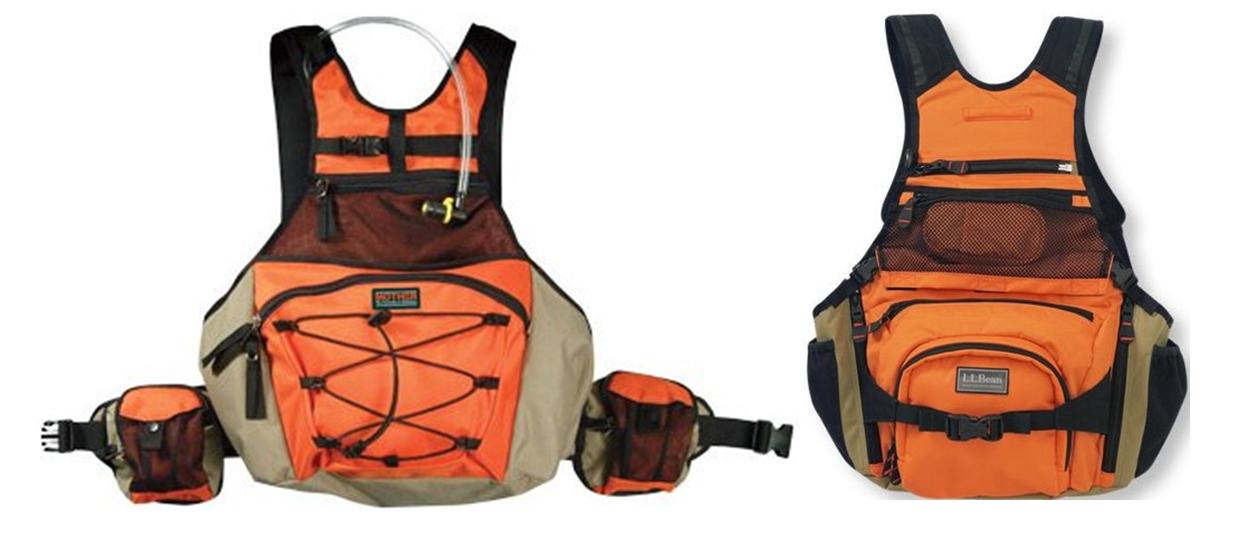
Trade dress infringement?
Mother Daypack (with belt extended) and Bean Upland Vestpack
The court characterized the undisputed facts as follows: “The parties met in December 2004 to discuss the possibility of Bean selling the Mother Daypack, an upland hunting pack designed and sold by Mother. Bean began selling the Mother Daypack through its website and catalogue in July 2005. The Bean catalogue containing a one-page display of the Mother Daypack, was distributed to an estimated 1.2 million households. Bean then decided to produce its own Upland Vest Pack which they began selling in July 2006, terminating sales of the Mother Product.”
In order to succeed on its trade dress claims at trial, the court found Mother will need to prove: (1) secondary meaning, (2) non-functionality, and (3) likelihood of confusion. Magistrate Judge Kelley Arnold found that genuine issues of disputed fact on each of these elements made summary judgment improper.
On the secondary meaning element, the court found: “This is not a case where (1) there had been no relationship between the parties before the alleged infringement; (2) the alleged infringer had not sold the very product at issue prior to manufacturing the product in dispute; (3) there was a lapse of time between the utilization of plaintiff’s product by defendant and defendant’s production of the challenged product. While these non-exclusive factors are not dispositive they raise sufficient inferences to overcome summary judgment with regard to secondary meaning.
As to functionality, the court found: “Clearly the product in question has a specific functional purpose. Arguably, some of the trade dress issues raised by plaintiff are functional, some are quasi-functional, and some design components. The court cannot say as a matter of law that plaintiff’s trade dress allegations must be disposed of on the basis of functionality.”
“With regard to the element of confusion, the fact that defendant sold plaintiff’s product under plaintiff’s name and in rapid succession replaced it with [its] own remarkably similar product creates a threshold for confusion. If the fact-finder were to find ‘intentional copying’ that alone could create a question of fact with regard to confusion based on the advertising and marketing techniques.”
The case cite is Mother, LLC v. L.L. Bean, Inc., No. 06-5540 (W.D. Wash. 2007).
Michael Atkins
in Seattle Updates, Trade Dress
|
Post a Comment
| Email
| Print
Prof. McCarthy Calls 2nd Circuit's Bukhara Decision an "Embarrassment"
The July issue of InsideCounsel magazine reviews the Second Circuit’s March 28 decision on famous foreign trademarks in ITC Limited vs. Punchgini, Inc., __ F. 3d. __, 2007 WL 914742, No. 05-0933 (2nd Cir.). In that case, New Delhi’s Bukhara Restaurant claimed it should be able to enforce its internationally-famous mark despite its abandonment of the mark here. The defendants were owners of a Manhattan Indian restaurant who called their establishment the “Bukhara Grill” because there was “no restaurant Bukhara in New York, and we just thought we will take the name.” The Bukhara Grill also copied the Bukhara Restaurant’s “logos, decor, staff uniforms, wood-slab menus, and red-checkered customer bibs.” Departing from the Ninth Circuit’s decision validating the famous marks doctrine in Grupo Gigante S.A. de C.V. v. Dallo & Co., 391 F.3d 1088, (9th Cir. 2004), the Second Circuit found that continuing international use of a famous trademark was not sufficient to sustain trademark or trade dress infringement claims under U.S. law. The Second Circuit certified to the New York Court of Appeals the question of whether such a right existed under New York state law.
When InsideCounsel asked Prof. J. Thomas McCarthy about the decision, he did not hold back. “They were wrong,” he said. “There was a way to [implicitly] incorporate the doctrine into the federal trademark statute. But the 2nd Circuit wanted to see explicit words saying the doctrine is enforceable. They gave a narrow reading to the statute.”
Prof. McCarthy warned that the decision has international implications. “This decision can be used as a club to beat our trade negotiators, with foreign governments saying, ‘Who are you to criticize us? You are not living up to your treaty obligations.”
As he told InsideCounsel, the decision is “a great embarrassment for the U.S.”
Michael Atkins
in Trade Dress, Trademark Infringement
|
Post a Comment
|
 1 Reference
| Email
| Print
1 Reference
| Email
| Print
Ninth Circuit Reverses Finding that FREEK Infringes MONSTER Drink's Trade Dress
On June 29, the Ninth Circuit reversed the Central District of California’s injunction against the defendant soft drink maker in Hansen Beverage Co. v. National Beverage Corp. that had enjoined defendants from selling or marketing their FREEK line of energy drinks.
Hansen produces and markets the MONSTER ENERGY line of energy drinks, each packaged in containers bearing a large clawed-out “M” and the word “MONSTER.” Each variety uses a distinct color combination that generally consists of a dark background and one bold accent color unique to the variety.
In August 2006, National began selling its line of FREEK energy drinks in the Detroit area. Like MONSTER drinks, the FREEK line of beverages consists of four flavor varieties, each packaged in containers featuring a dark background and one of four distinctive accent colors. Unlike the MONSTER drinks, however, FREEK’s packaging prominently features the word “FREEK” written in a unique, stylized font and the distorted image of an evil-looking creature’s face.
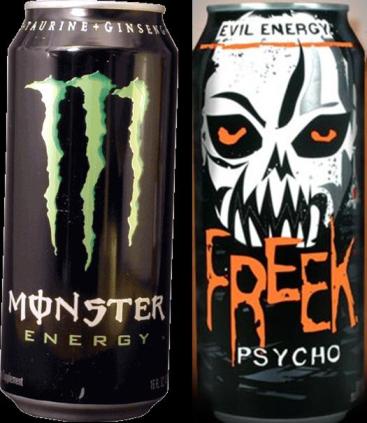
Confusingly similar? The Subject Energy Drinks
Soon after National began distributing its product, Hansen filed suit under Section 43 of the Lanham Act, alleging that National’s FREEK line of energy drinks infringes the trade dress of Hansen’s MONSTER drinks. The Central District found National’s FREEK trade dress was indeed confusingly similar with Hansen’s MONSTER trade dress. Therefore, it granted a preliminary injunction prohibiting National from “manufacturing, distributing, shipping, advertising, marketing, promoting, selling, or offering to sell the Freek energy drinks in containers the same or similar to their current containers or any containers confusingly similar to Plaintiff’s current Monster trade dress.”
In a published decision, the Ninth Circuit found the Central District’s finding of likelihood of confusion was clearly erroneous and reversed. It concluded: “The two trade dresses are similar in overall appearance only to the extent that they both feature ‘aggressive’ graphics and bold accent colors against dark backgrounds. However, these elements are widely employed in the crowded energy drink market and are therefore, unlikely to lead to confusion as to source.”
It added: “The appearance of the competing trade dress speaks for itself. Monster products are distinguishable from the other energy drinks on the market largely because the word ‘Monster’ and a large ‘M’ are prominently displayed on the cans. Freek’s trade dress does not feature either of these source-identifying marks; instead, it displays prominently its own trade name (‘Freek’) along with a distinctive depiction of a distorted and frightening face (the so-called ‘Freek Man’). These very significant differences weigh heavily against a finding that consumer confusion is likely to result from the overall look of the packaging.”
The court also rejected Hansen’s argument that the “Freek Man” is the picture equivalent of the word mark “MONSTER,” on the ground that the MONSTER word mark “is so broad and ambiguous that consumers are unlikely to equate it with any particular image or symbol — much less an image as disembodied and stylized as the Freek Man.”
The case cite is Hansen Beverage Co. v. Nat’l Beverage Corp., __ F.3d __, 2007 WL 1859607, No. 06-56390 (9th Cir.).
Thanks to the IP Law Observer for bringing this decision to my attention. (Read IPLO’s summary of the case here.) For some reason, I missed it myself the first time around.
Michael Atkins
in Trade Dress
|
Post a Comment
|
2 References
| Email
| Print
Can a Restaurant Protect Its Decor? Its Recipes? Bob Cumbow Tells All
Yesterday, The New York Times reported on a lawsuit one restaurant owner instituted against another for copying “each and every element” of her restaurant, including “the white marble bar, the gray paint on the wainscoting, the chairs and bar stools with their wheat-straw backs, the packets of oyster crackers placed at each table setting and the dressing on the Caesar salad.”
 The Times goes on to quote celebrity chef Tom Colicchio of “Top Chef” fame (pictured right), who expressed frustration over his perceived inability to stop a sandwich shop from cloning his “Witchcraft” restaurants: “There’s nothing you can do,” he said. “You can’t protect recipes, you can’t protect what a place looks like, it’s impossible.”
Unless you know a trademark lawyer, that is. Here is my partner Bob Cumbow’s (pictured bottom right) take on the issue:
“As I read the story, three issues are raised, one with an easy answer, two others not so.
 “1. One of the persons asks, How can you protect the way a place looks? He’s obviously unfamiliar with Two Pesos v. Taco Cabana, in which the U.S. Supreme Court confirmed that trade dress applies to restaurant decor and that it can be protectable even without secondary meaning, as long as it is shown to be inherently distinctive — which is the challenge facing the plaintiff in this case.
“2. Are recipes and menus protectable? Under copyright law, probably not, except to the extent that they embody original expression. Also, a list of items, each unprotectable alone, may be protected as an original selection and arrangement under Feist v. Rural Telephone — but with respect to an oyster house menu this would be a very ‘thin’ copyright, since the offerings of restaurants within such a narrow niche are likely to be substantially similar from one restaurant to another, and protecting one party’s menu from another party’s even near-identical menu could be the first step on a ‘slippery slope’ of granting one restaurateur exclusive rights in something that its competitors ought to be allowed to do.
“3. Can recipes and menus be included as part of a restaurant’s overall trade dress? Probably not, because they are almost certainly functional. But this is a novel argument that may seek to expand the notion of ‘tertium quid’ trade dress to include menu offerings as part of the overall ‘look and feel’ of a restaurant. I’d be surprised if it were successful — but I’ve been surprised before.”
Great analysis, Bob. Thanks for sharing!
The case cite is Powerful Katinka, Inc. v. McFarland, 07-6036 (S.D.N.Y).
Photo credits: Bravo TV and Graham & Dunn PC