
Entries in Trade Dress (53)
Paint Remover Makers Settle Trademark and Trade Dress Dispute
Last July, Bellingham, Wash.-based Homax Products, Inc. filed a declaratory judgment action against Dynacraft Industries, Inc. Both parties manufacture paint removal products that change color to signify when the paint they are applied to is ready to be stripped.

One of Dynacraft’s READY STRIP products
Homax’s complaint stemmed from a cease-and-desist letter it received from Dynacraft in May 2006, which allegedly claimed that:
- Homax’s use of NATURE’S OWN for its paint strippers infringes Dynacraft’s federally-registered mark, BACK TO NATURE;
- Homax’s use of the the phrase “Color Changing Paint Stripper” infringes Dynacraft’s common law trademark rights in COLOR CHANGING PAINT STRIPPER; and
- Homax’s “selection of verbiage” in two of its labels are “close in comparison with the copyrighted verbiage in Dynacraft’s ‘Ready Strip’ label.”
The complaint asked the Western District to determine that Homax “has not infringed Dynacraft’s alleged federal trademark registration for ‘Back to Nature’”; that “Dynacraft has no rights in the term ‘nature’ apart from any rights it has in the mark ‘Back to Nature’”; that “Dynacraft has no trademark rights in the generic and/or merely descriptive phrases ‘color changing’ and ‘paint stripper’”; that Homax has not infringed Dynacraft’s trade dress; and that Dynacraft has no protectable trade dress in the packaging of its products.
In Oct. 2006, Dynacraft answered Homax’s complaint and asserted counterclaims that Homax was indeed infringing its trade dress and trademark rights. (The answer is worth checking out for the color exhibits on pages 20 and 21 illustrating the products’ similar trade dress.)
The parties recently made nice. Today, they filed a Stipulation and Order of Dismissal stating they had settled their differences and agreed that all claims and counterclaims between them should be dismissed with prejudice.
The case cite is Homax Products, Inc. v. Dynacraft Industries, Inc., No. 06-990 (W.D. Wash.).
 Michael Atkins
in Seattle Updates, Trade Dress, Trademark Infringement
|
Michael Atkins
in Seattle Updates, Trade Dress, Trademark Infringement
|
 Post a Comment
|
Post a Comment
|  Email
|
Email
|  Print
Print
No Fees Award in Mother v. LL Bean Trade Dress Case
I’ve probably over-done my coverage of this case, but it’s been a fun one. To close the loop, I’ll just say that on Oct. 26, the Western District declined to award L.L. Bean, Inc., attorney’s fees, which L.L. Bean sought after obtaining dismissal of Mother, LLC’s trade dress infringement claims as a matter of law at the close of trial.
After noting that fees awards are discretionary and the Ninth Circuit has “set the bar fairly high with regard to what constitutes ‘exceptional,’” the court explained its decision as follows:
“The court found this case distinguishable from many, in that the parties had entered into a contractual arrangement regarding the sale and marketing of the plaintiff’s upland hunting vest by defendant. Defendant’s conduct was more than suspect from an equitable perspective, but because Congress was careful not to stifle competition, the plaintiff had a significant burden in establishing a prima facie case of trade dress infringement. The court’s oral opinion sets forth the basis for granting the defendants’ motion at the end of the plaintiff’s case and need not be repeated here. It was not based on allegations which were vexatious and/or made in bad faith. This case was, in fact, one of the few where equity and empathy favored the plaintiff and in the final analysis the law favored the defendant.”
The case cite is Mother, LLC v. L.L. Bean, Inc., No. 06-5540, 2007 WL 3223223 (W.D. Wash.).
Michael Atkins
in Seattle Updates, Trade Dress
|
Post a Comment
| Email
| Print
Bourne Ultimatum: Vancouver Furniture Importer Settles Trade Dress Case
On Sept. 25, Vancouver, Wash.-based furniture importer Bourne International, Inc., settled its trade dress and copyright infringement claims against Chet Stoler and his company, South Seas Trading Co. (Previous STL coverage discussing the Western District’s refusal to enter the parties’ stipulated protective order here.)
Bourne had alleged that Mr. Stoler, a former Bourne officer, director, and shareholder, had been responsible for the manufacturing, designing, importing, and marketing of Bourne’s furniture lines, including a line called THE LEAF COLLECTION. Bourne alleged that Mr. Stoler set up a competing importing business and sold items from THE LEAF COLLECTION to Bourne’s customers without Bourne’s authorization, infringing Bourne’s trade dress.
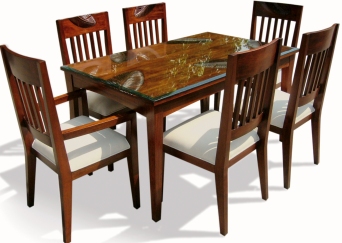
The parties’ Stipulation and Final Judgment describes THE LEAF COLLECTION’s trade dress as: “banana leaves, reticulate venaton on each banana leaf, each leaf has dark shading representing the venation and outline, the leaves are approximately uniform in size, the leaves are carved, a pattern of banana leaves at different angles to one another, and a dark, mahogany wood color.”
As part of the settlement, the parties agreed that “[u]nless Plaintiff receives injunctive relief enjoining Defendants’ confusing sale of items falling within Plaintiff’s copyright and trade dress for THE LEAF COLLECTION©™ in the sale, marketing, and advertising of imported furniture, Plaintiff will be irreparably injured.” The proposed order permanently enjoins defendants from deriving compensation from the sale or manufacture of furniture, or colorable imitations thereof, from Bourne’s furniture lines, including THE LEAF COLLECTION.
The parties also agreed to dismiss all of their claims and counterclaims against each other with prejudice, without fees or costs to any party.
The case cite is Bourne International, Inc. v. Stoler, No. 06-5680 (W.D. Wash.).
Michael Atkins
in Seattle Updates, Trade Dress
|
Post a Comment
| Email
| Print
Scotts and TerraCycle Settle; "Sued by Scotts" Web Site to Come Down
The Scotts Company and its parent, OMS Investments, Inc., have settled their trade dress and false advertising dispute with TerraCycle, Inc., the parties announced today. (STL’s May 16 post about the case here.) Scotts sells the MIRACLE-GRO line of plant food; TerraCycle sells plant food under its own name. Both use green and yellow packaging.


TerraCycle will drop its green-and-yellow packaging (left);
Scotts will drop its lawsuit.
As part of the Sept. 15 settlement, Scotts dismissed the case it filed in the District of New Jersey. In exchange, TerraCycle, while not admitting liability, agreed to phase out all use of specified trade dress, any trade dress that is confusingly similar with Scotts’ MIRACLE-GRO trade dress, and any trade dress that is confusingly similar to Scotts’ “green and yellow” trade dress.
TerraCycle also agreed to take down its “Sued by Scotts” Web site within three months. The site received prominent media attention during the litigation, including from the New York Times and Wall Street Journal.
Interestingly, and perhaps disturbingly, the Stipulated Order of Dismissal not only dismisses the case, but it also finds: “The following marks are valid, enforceable, fully subsisting, inherently distinctive, strong, famous and have acquired secondary meaning in the marketplace within the meaning of the Lanham Act, as amended, 15 U.S.C. § 1051 et seq.: (i) the MIRACLE-GRO Trade Dress, as exemplified in Exhibit B hereto; and (ii) the Green and Yellow Trade Dress, subject of Trademark Registration No. 2,139,929, attached as Exhibit C hereto.”
I suppose this seemingly gratuitous language is ok if, in signing the parties’ stipulation, the court really meant to find that Scotts’ trade dress is “valid, enforceable, fully subsisting, inherently distinctive, strong, famous and have acquired secondary meaning.” But if all the court meant to do was dismiss the case, or to find that the parties had agreed between themselves that the subject trade dress was “valid, enforceable, fully subsisting, inherently distinctive, strong, famous and have acquired secondary meaning,” this language is misleading.
The case cite is OMS Investments, Inc. v. TerraCycle, Inc., No. 07-1064 (D. N.J.).
Full disclosure: I am defending an opposition proceeding brought by OMS Investments, Inc. (though it’s not a trade dress case). Maybe that makes me overly-sensitive. You be the judge.
Western District Dismisses Mother's Trade Dress Claims Against LL Bean
On Sept. 18, Western District Magistrate Judge Kelley Arnold granted L.L. Bean, Inc.’s motion for judgment as a matter of law, dismissing Mother, LLC’s trade dress claims stemming from the parties’ competing hunting vests. The court granted the motion after Mother rested its case on the second day of trial.
The docket’s minute entry is dramatic in its own way: “Plaintiff rests. Jury excused. [L.L. Bean] moves for judgment as a matter of law; [Mother] argues - Granted. Court is at recess.” Sometimes, justice is swift.
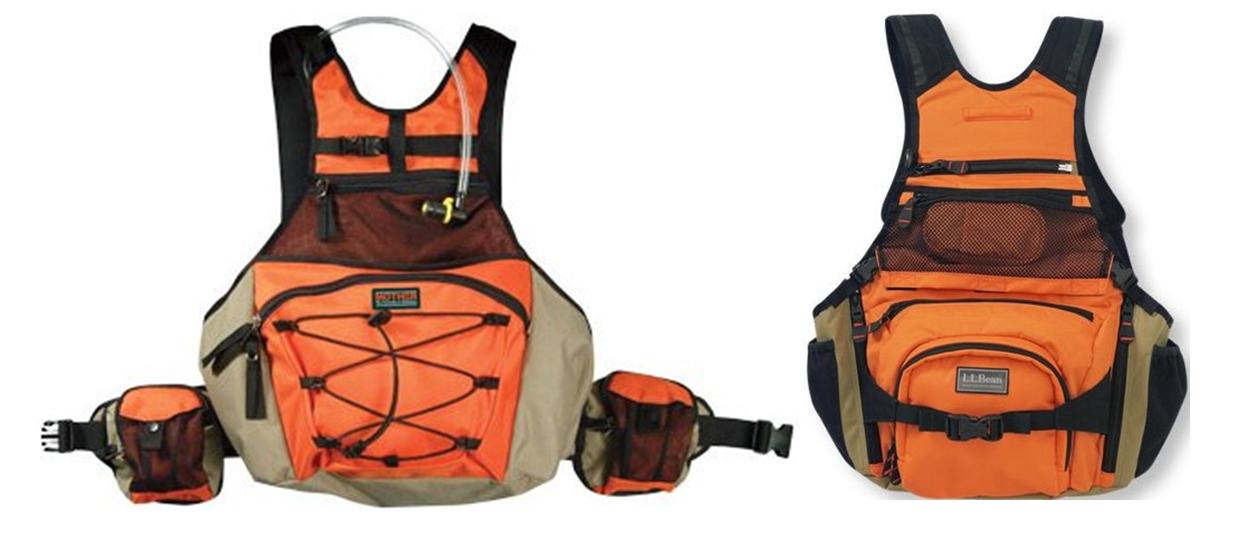
Western District finds no trade dress infringement:
Mother Daypack (with belt extended) and Bean Upland Vestpack
For additional background, check out STL’s posts on the case from April 9, August 8, August 25, and September 16.
The case cite is Mother, LLC v. L.L. Bean, Inc., No. 06-5540 (W.D. Wash.).
Michael Atkins
in Seattle Updates, Trade Dress
|
Post a Comment
| Email
| Print