
Entries in Trade Dress (53)
Local Media Spotlight Restaurant Trade Dress Trial
The Peso’s vs. Matador restaurant ripoff case starts Monday.
The lawsuit, which Peso’s Kitchen and Lounge owners El Diablo, Inc., and Brian Hutmacher filed against Mel-Opp & Griff LLC and the other owners of competing Tex-Mex restaurant The Matador, accuses the latter of copying the former’s distinctive menu and decor. (Previous STL coverage here and here.)
The local media has glommed onto the story, with an article in the Seattle Weekly and a spot on KING-TV (video, text).

KingTV’s shot of The Matador in Seattle’s Ballard neighborhood.
The Weekly story has nice color:
“On Super Bowl Sunday 2004, Brian Hutmacher wasn’t thinking about the point spread or Janet Jackson’s wardrobe malfunction. He was staring at the metallic, Mexican-inspired decor of the just-opened Matador restaurant in Ballard, thinking it looked a lot like his own wildly popular tequila-and-nachos late-night hangout, Peso’s.
“Then he saw the menu. The main entree page had 11 items. ‘Eight of those 11 items are identical in name, description, price, and preparation to what is on the menu at Peso’s,’ Hutmacher later wrote in a 20-page, obscenity-laced letter to one of Matador’s owners.”
The trial should be colorful, too.
It will be decided by King County Superior Court Judge Catherine Schaffer without a jury.
The case cite is El Diablo, Inc. v. Mel-Opp & Griff LLC, No. 07-2-01203-6 SEA (King County Super.).
 Michael Atkins
in Seattle Updates, Trade Dress
|
Michael Atkins
in Seattle Updates, Trade Dress
|
 Post a Comment
|
Post a Comment
|  Email
|
Email
|  Print
Print
King County Superior Court Sends Local Trade Dress Dispute to the Jury

Restaurant wars: The owner of Peso’s (left) has sued the owners
of The Matador over trade dress, dilution and other issues.
As STL readers may recall, El Diablo, Inc., and its owner sued Mel-Opp & Griff, LLC, and others in King County Superior Court for trade dress infringement, dilution, and other claims relating to the parties’ competing Tex-Mex restaurants and bars.
Plaintiffs own Peso’s Kitchen & Lounge in lower Queen Anne. Defendants own The Matador restaurants in Ballard, West Seattle, and other locations.
In June, defendants brought several motions for summary judgment, including one seeking dismissal of plaintiffs’ trademark-related claims based on laches. In summary, defendants argued that plaintiffs’ alleged three-year delay in bringing suit unfairly prejudiced them.
Plaintiffs argued in response that laches applies under the Lanham Act because it does not contain an express limitations period but does not apply to their state trademark claims because a statutory limitations period applies instead.
On July 8, King County Superior Court Judge Catherine Shaffer denied the laches motion in a minute order. Unfortunately, the order does not explain the court’s reasoning.
The court also denied defendants’ motion on causation and damages. It granted defendants’ motion dismissing plaintiffs’ tortious interference, breach of fiduciary duty, and fraud claims.
The court previously denied defendants’ motion for summary judgment dismissal of plaintiffs’ dilution claim.
Earlier this month, the court amended the case schedule setting the parties’ expected three-week jury trial for Sept. 15.
The case cite is El Diablo, Inc. v. Mel-Opp & Griff LLC, No. 07-2-01203-6 SEA (King County Super.) (Shaffer, J.).
Michael Atkins
in Seattle Updates, Trade Dress
|
Post a Comment
| Email
| Print
Peso's Sues Matador in Rare Seattle Restaurant Trade Dress Case

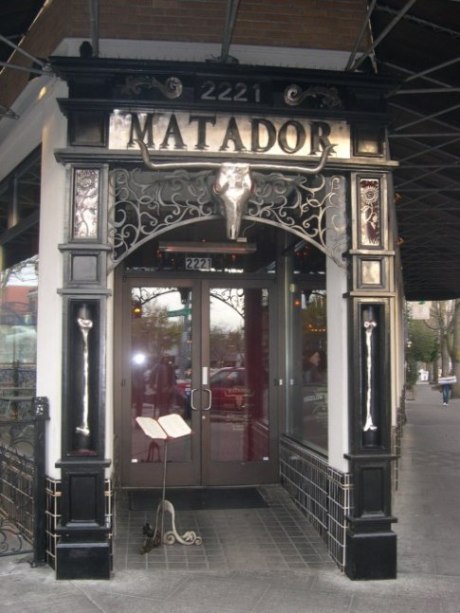
The owner of Peso’s Kitchen and Lounge (top) has sued the owner of
The Matador restaurant for trade dress infringement, including the
metal work shown above, allegedly made by the same designer.
Last year, El Diablo, Inc. filed suit for trade dress infringement in King County Superior Court against Mel-Opp & Griff LLC and other defendants alleging confusing similarity between the look-and-feel of the parties’ competing Mexican/Tex-Mex restaurants and bars. El Diablo owns Peso’s Kitchen and Lounge in lower Queen Anne. Mel-Opp & Griff owns The Matador, located in Ballard, West Seattle, Redmond, Tacoma, and Portland, Oregon.
El Diablo claims that its former employees and independent contractors jumped ship and opened The Matador, copying what it considers to be its distinctive trade dress, which it describes in part as follows: “ornamentation, designs, and decorative elements in sconces, lighting, chandeliers, wall surface treatment and colors, ceiling panels and colors, furnishings, Mexican ‘Day of the Dead’ themes and the adoption of a matador graphic design and icon on the menu cover….”
El Diablo also claims the defendants copied its distinctive recipes and menu.
The defendants deny the allegations.
On March 14, Judge Catherine Shaffer denied defendants’ motion for partial summary judgment to dismiss a claim under Washington’s dilution statute.
Trial is scheduled for July.
The case cite is El Diablo, Inc. v. Mel-Opp & Griff LLC, No. 07-2-01203-6 SEA (King County Super.).
Michael Atkins
in Seattle Updates, Trade Dress
|
Post a Comment
| Email
| Print
Class Notes: Trade Dress Presentation
I was fortunate enough to fill in for my esteemed partner, Bob Cumbow, last night in his trademark law class at Seattle University. The subject was trade dress — one of my favorites. Here’s a copy of my PowerPoint talking points. Why was Bob absent? He’s in the “other” Washington speaking at Howard University School of Law’s Institute of Intellectual Property and Social Justice CLE on “Louis Vuitton, Starbucks, and the Red Hot Chili Peppers: The Trademark Year in Review.” Wish I could be there for that one, but am so glad I could get back to teaching — if only for one night.
Michael Atkins
in Seattle Updates, Trade Dress
|
1 Comment
| Email
| Print
Wrestler "Warrior" Avoids Game Maker's Motion to Dismiss Trademark Claims
Ultimate Creations, Inc., the licensing company owned by former professional wrestler Warrior (his legal name) brought suit in the District of Arizona against video game maker THQ Inc. over video games that use Ultimate’s WARRIOR registered trademark and and trade dress in the wrestler’s costume and image. THQ moved for summary judgment on grounds of fair use and the protectability of Ultimate’s unregistered trade dress. On Jan. 24, Judge Stephen McNamee found in Ultimate’s favor.
The court summarized the facts as follows:
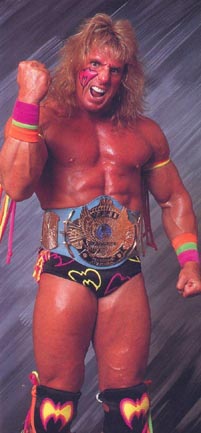 “Warrior claims that his wrestling character was distinctive because he had long, flowing hair, wore arm pads and knee pads with a fringe, displayed on his costume and face a logo roughly in the shape of an upside-down ‘W’ — the logo, originated from ‘Parts Unknown,’ had an exceptionally muscular build, and used ‘signature’ moves in his wrestling performances.
“In 2003, the parties entered into negotiations to license intellectual property associated with Warrior. The draft license agreement included the use of Warrior’s ‘name, voice, facsimile signature, nickname, likeness, signature moves, entrance music, endorsement, right of publicity, and biographical sketch as it may appear in photographs, film, video clips, etc.’ However, the negotiations eventually terminated without entering into a contract.”
In the lawsuit, “Plaintiff alleges that Defendant began to use the likeness, moves, trade dress, marks, and other intellectual property associated with Warrior in its video game as early as October of 2003. Specifically, players may use the [Create-A-Wrestler] feature on the games to create a character that has a similar build, face paint, and logo symbol as Warrior, that uses the entrance and finishing moves found under the label ‘OUW’ that are similar to Warrior’s, that has the call name ‘The Warrior’ or ‘Warrior,’ and is from ‘Parts Unknown.’ Plaintiff contends that this feature causes confusion as to whether Plaintiff sponsored or is associated with the game.”
On THQ’s fair use defense, the court concluded: “Defendant argues that it used the name ‘Warrior’ descriptively and not as a mark, and thus its use was fair. Despite this assertion, the Court finds that a jury could find that neither the mark nor the similar symbol was used in good faith based on the prior, unsuccessful negotiations between the parties. What is clear is that the use of the name Warrior was not necessary to create or market the video games. Also, the combination of signature moves, the face paint, the similar symbol and ‘Warrior’ call name suggests that Defendant intentionally provided the tools for consumers to create a wrestler in the likeness of Warrior without regard to his intellectual property rights. Thus, a jury could conclude that Defendant’s use was an improper attempt to capitalize on the popularity of the Warrior wrestling character. As such, summary judgment on Plaintiff’s claim of infringement of registered trademarks and service marks is not proper.”
As for Ultimate’s trade dress claim, the court found: “Warrior’s trade dress involves the costume, symbol, face paint, and color combinations that make up the overall image of his wrestling character. Through the video games, Defendant has made these elements available to its consumers. The websites where players exchange information regarding how to create the Warrior wrestling character suggest that Warrior has a distinctive trade dress, which supports a finding of secondary meaning in Warrior’s overall appearance, and denotes possible confusion as to whether the video games are affiliated with Warrior himself. The elements of trade dress also appear to be non-functional, and the combination of the elements may be sufficient to create a distinctive trade dress that is capable of protection. Thus, taken as a whole, a reasonable person could find that Defendant has committed a violation of Plaintiff’s unregistered trademarks or trade dress under Section 43(a) by confusing consumers as to Plaintiff’s affiliation, connection, or association with Defendant’s games.”
The case cite is Ultimate Creations, Inc. v. THQ Inc., 2008 WL 215827, No. 05-1134 (D. Ariz. Jan. 24, 2008).
Michael Atkins
in Trade Dress, Trademark Infringement
|
Post a Comment
|
 3 References
| Email
| Print
3 References
| Email
| Print