
Entries in Trade Dress (53)
Would Smith's Owner Have Had a Claim for Trade Dress Infringement?
It’s not going to turn into a lawsuit, but check out the photos below of Seattle’s Smith bar and Starbucks’ adjacent 15th Street Coffee & Tea, which opened on Friday. Smith owner Linda Derschang initially cried foul about Starbucks’ design, saying it copied the look-and-feel of her neighborhood pub. However, she changed her mind, saying the differences in the parties’ offerings would help avoid harm.
Outside, both establishments have the same brownish-grey exterior color and similar (but differently colored) awnings. Inside, both have a lot of exposed wood (including bars, tables, and chairs) and share a rustic feel. Both have hanging lamps, exposed wood beams, exposed electrical work, and exposed duct work. Perhaps most notably, both have display signs consisting of chalkboards framed in reclaimed wood and large wood-framed antique paintings. Both establishments sell beer and wine. Both offer food, though Smith offers pub fare and 15th Street most prominently offers baked goods.
For the sake of discussion, would all this add up to a successful claim of trade dress infringement? Remember, to be protectable, trade dress needs to be nonfunctional (e.g., every bar has tables, chairs, a bar, and a cash register, so those features don’t count) and distinctive (either because the trade dress is “suggestive,” “arbitrary,” or “fanciful,” or because the trade dress is “descriptive” and has acquired distinctiveness through secondary meaning). And to be actionable, the later adopter’s use of similar trade dress needs to be likely to confuse consumers into believing some association exists with the senior adopter (in this case, that 15th Street has something to do with Smith, like has a common owner or that Smith’s owner approved Starbucks’ use of a similar design).
Taking all this into account, would Smith’s owner have had a valid claim?
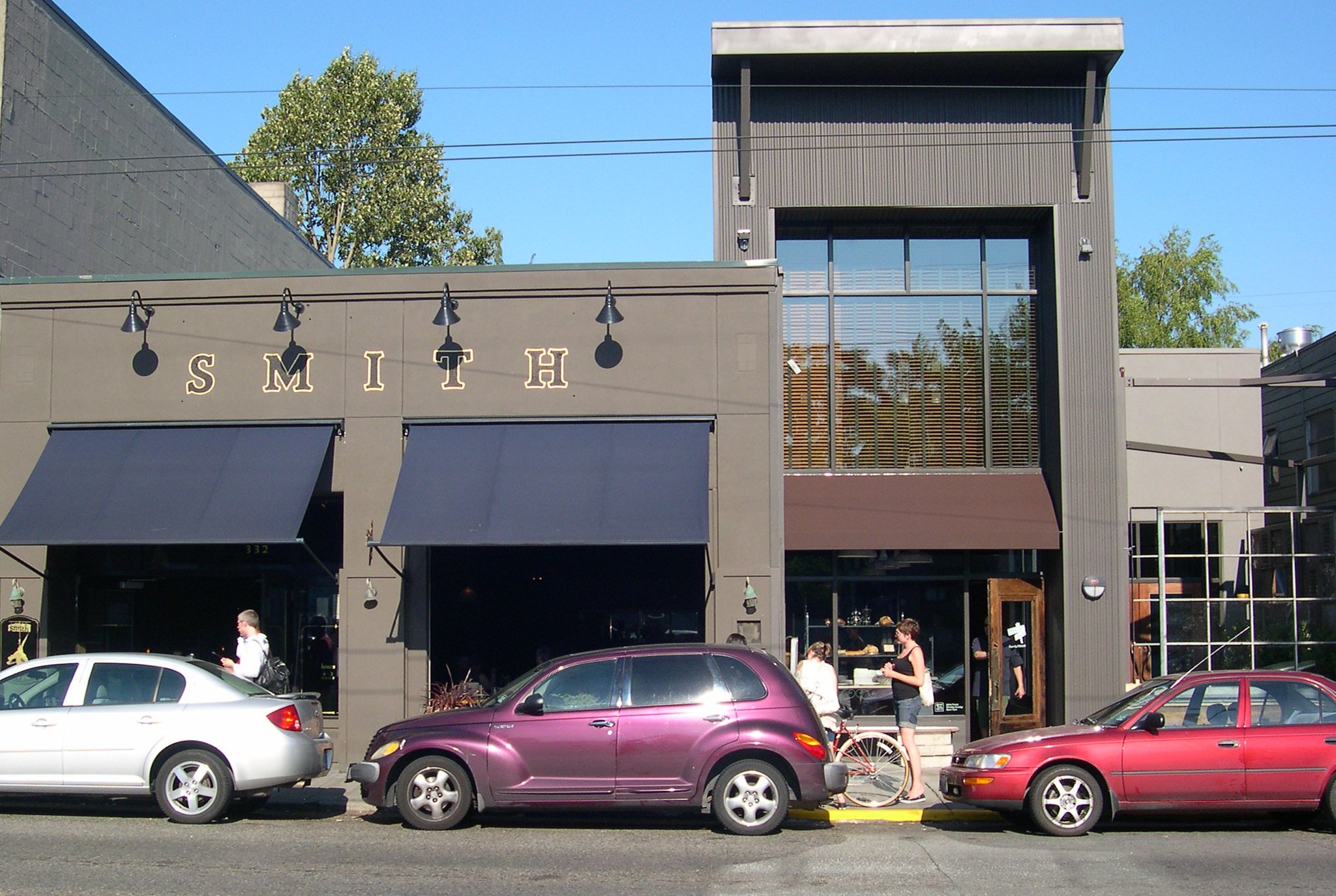
Exteriors of Smith (left) and Starbucks’ new 15th Street Coffee & Tea
(with open door between purple and red cars). (Photo by STL)
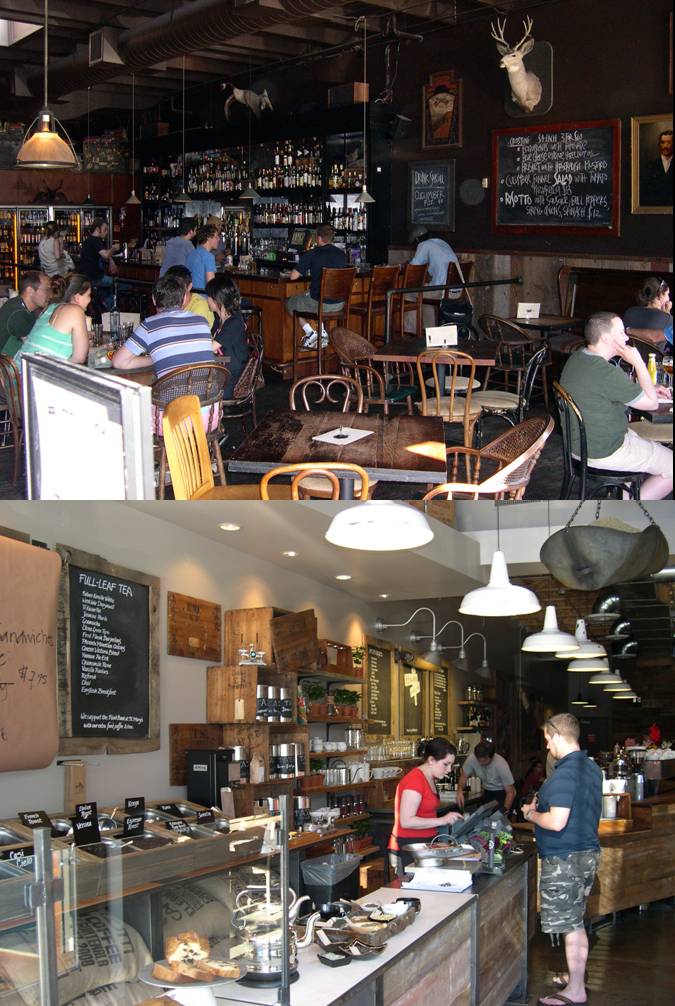
Interiors of Smith (top) and 15th Street Coffee & Tea. (Photos by STL)
 Michael Atkins
in Seattle Updates, Trade Dress
|
Michael Atkins
in Seattle Updates, Trade Dress
|
 Post a Comment
|
Post a Comment
|  Email
|
Email
|  Print
Print
No Peso's-Matador Redux; Seattle Bar Owner Says She's "Over" Copied Features
Seattle bar queen Linda Derschang called off her meeting with Starbucks over the features she believed the coffee company copied from her neighboring bar, “Smith.” (Previous STL post here.)
“I feel already over it,” Ms. Derschang told the Seattle Post-Intelligencer. “It’s just not that big of a deal.”
Just a few days ago, Ms. Derschang ripped Starbucks in the press, accusing the company of turning its soon-to-open unbranded 15th Avenue Coffee and Tea store into a Smith lookalike.
She railed in The Slog: “Have you seen the color of the new Starbucks on 15th? Noticed the salvaged wood wall outside which is the same as my salvaged wood planter box in front of Smith? Poke your head in and check out the salvaged wood frames on the walls, the vintage industrial light fixtures, and the old wooden seats. … I can’t believe that anyone, whether a hair salon or a coffee chain, would just go ahead and knock off their next door neighbor’s exterior….”
Ms. Derschang reportedly had lined up a meeting with Starbucks to talk about her concerns before having her abrupt change of heart.
She now says the differences in the parties’ services distinguish her case from the Peso’s-Matador lawsuit that settled last year. Even though Starbucks’ new store will sell beer and wine, they’re not a restaurant and bar, she said.
“They are selling coffee, and we’re a restaurant and bar. So many people sell beer and wine on our street I don’t think that’s really a huge deal. It’s more about them trying out this new concept.”
Michael Atkins
in Seattle Updates, Trade Dress
|
Post a Comment
| Email
| Print
Peso's-Matador Redux? Seattle Bar Claims Neighbor Copied Its Trade Dress
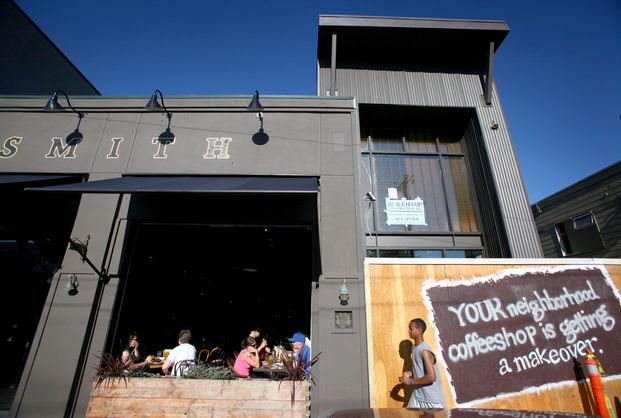
The owner of Capitol Hill’s Smith (left) claims Starbucks’ forthcoming
shop next door unfairly mimics her bar’s look-and-feel.
Photo credit: Joshua Trujillo / Seattle PI
Capitol Hill bar maven Linda Derschang claims a neighboring Starbucks store that’s undergoing renovation has copied the look and feel of her Smith restaurant and bar.
She told the now solely-online Seattle Post-Intelligencer (article here) that the 15th Avenue Starbucks — soon to be rebranded as “15th Avenue Coffee and Tea” — mimics her hunting-lodge-esque hipster haven.
“It’s got a lot of salvaged wood, it’s the same paint color inside as Smith and some of the wood framed chalkboards look very, very similar,” she said. “If they had decided to do that look in a different neighborhood or city that would be one thing, but trying to position themselves as an independent coffee house? Where’s the independent spirit in knocking someone off?”
Starbucks representative Anna Kim-Williams told the PI the coffee company is trying to fit in better with the neighborhood. “We’re continuing our commitment to delivering specialty coffee excellence while refreshing our store design approach with an amplified focus on local relevance,” she said.
After the remodel, Starbucks will sell beer and wine as well as coffee.
The PI says Ms. Derschang is meeting with Starbucks to discuss her concerns on Monday.
This dispute may remind STL readers of the trade dress lawsuit between Seattle’s Peso’s and Matador Tex-Mex restaurants and bars that settled last year (STL’s initial post on that dispute here).
Additional coverage at The Slog.
Michael Atkins
in Seattle Updates, Trade Dress
|
Post a Comment
| Email
| Print
Adidas Sues Topline over Stripes and Shoe Designs
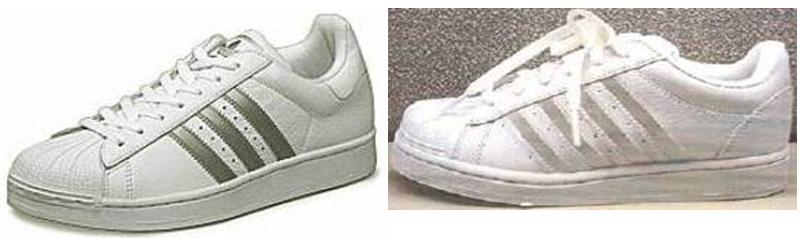
Adidas’ 3-stripe “Superstar” shoe (left)
and Topline’s allegedly infringing four-stripe shoe
On May 11, Adidas America, Inc., filed a trademark infringement lawsuit in the Western District against Bellevue-based shoe maker The Topline Corporation. Adidas alleges that Topline’s two- and four-stripe shoe designs infringe Adidas’ three-stripe design as well as the trade dress of Adidas’ “Superstar,” “Mei” and “Pranja” shoes.
Interestingly (to me at least), Adidas describes its “Superstar” shoe trade dress as including “a unique and non-functional combination of three stripes on the side of the shoe parallel to the equidistant small holes, a rubber ‘shell toe,’ a particularly flat sole and a colored portion on the outer back heel section.”
Topline has not yet answered Adidas’ complaint.
Adidas brought a similar trademark lawsuit against Payless Shoesource, Inc., in the District of Oregon, which last year resulted in a $305 million jury verdict in Adidas’ favor (later reduced to $65 million).
Topline is no stranger to the Western District. In 2007, it brought two trademark suits against competing shoe makers 4273371 Canada, Inc., Flurt Footwear, and a dozen others. (See STL posts on Topline’s cases from April 12, 2007, July 5, 2007, August 14, 2007, and Oct. 28, 2007.)
Given the parties’ litigious natures, this case will be case one to watch.
The case cite is Adidas America, Inc. v. The Topline Corporation, No. 09-646 (W.D. Wash.).
Michael Atkins
in Seattle Updates, Trade Dress, Trademark Infringement
|
Post a Comment
| Email
| Print
Ninth Circuit Affirms Findings of Jewelry Trade Dress Trial
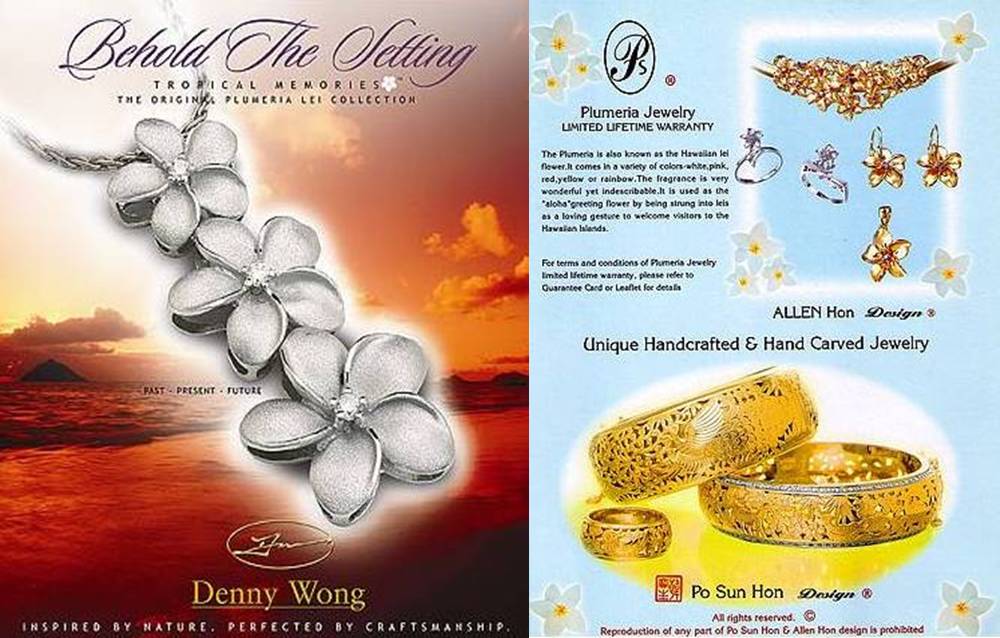
Trade dress infringement? Plaintiff’s and defendants’ jewelry designs
In Cosmos Jewelry, Ltd. v. Po Sun Hon Co., the Ninth Circuit considered a rare trade dress trial involving competing jewelry designs. In colorful language, the court affirmed the district court’s findings that plaintiff’s trade dress was distinctive and non-functional and, therefore, defendant was liable for infringement. The decision came down March 24.
“Unlike many copyright and trade dress cases, this one went to trial. We therefore review the findings of fact only to determine whether they are clearly erroneous, and do not review de novo as we would for summary judgment. In the hyperbolic language we first used in a trademark case, ‘[t]o be clearly erroneous, a decision must … strike us as wrong with the force of a five-week old, unrefrigerated dead fish.”
“Regarding trade dress, Hon appeals the adverse determination, and we again affirm, again because the case went to trial and our standard of review limits us to considering whether the findings were clearly erroneous. Though it is a stretch to compare identifying characteristics of jewelry to the green cover on an ironing board, Qualitex Co. v. Jacobson Prods. Co., Inc., 514 U.S. 159 (1995), the jewelry characteristics are not like the springs on a traffic sign, TrafFix Devices, Inc. v. Mktg. Displays, Inc., 532 U.S. 23 (2001). The district court found Cosmos’s trade dress, ‘plumeria flowers in yellow gold in a specific size and shape with a sandblasted matte finish on the petals and high-polished shiny edges,’ to be distinctive. Our precedents allow for the findings the district court made.
“The district court’s finding of non-functionality is not clearly erroneous. Cosmos’s distinctive use of common techniques, such as shiny edges and sandblasting, were not functional in the sense of providing a means for hanging the earrings securely on the ear or attaching other jewelry, which might be analogous to the springs in TrafFix, but merely for creating the distinctive aesthetic appearance of [plaintiff’s Denny] Wong jewelry. Au-Tomotive Gold, Inc. v. Volkswagen of America, Inc., 457 F.3d 1062, 1072 (9th Cir. 2006), does not help Hon, because Hon can avoid ‘a significant non-reputation-related competitive disadvantage’ by making and selling plumeria jewelry that does not look like Cosmos’s. There is evidence in the record supporting the district court’s finding that the Cosmos flowers were identified with the source, Wong’s design, and not merely with plumeria flowers, so had acquired secondary meaning. Hon does not challenge the finding of likelihood of confusion.”
In affirming the district court’s finding, the court upheld a $2.3 million judgment and award of attorney’s fees.
Press coverage of the case here and here.
The case cite is Cosmos Jewelry, Ltd. v. Po Sun Hon Co., Nos. 06-56338, 06-56240, 07-55333, 2009 WL 766517 (9th Cir.) (March 24, 2009) (unpublished).