
Entries in Trade Dress (53)
Turf Holdings Sues Former Franchisee Over Continued Use of Trade Dress
Franchise relationships are governed by contract.
Depending on the franchisor’s agreement with the franchisee, there are certain things a franchisee must do with regard to the franchisor’s trademarks once the franchise relationship is terminated.
Franchisor Turf Holdings, Inc., recently filed suit in the Western District against Vanderburg Corp., one of its former franchisees.
The complaint alleges that Vanderburg failed to remove Turf Holding’s trademarks pursuant to the parties’ franchise agreement, which also amounted to trademark and trade dress infringement. Turf Holdings separately moved for a preliminary injunction.
The complaint states: “Defendants refused to de-identify their business within three days as required by Section 9.2 of the Franchise Agreement, and have failed to do so to date. Specifically, Defendants failed to completely remove the ‘Weed Man’ mark from the door of their business and failed to change th vehicles’ distinctive green and yellow color scheme and tank configuration. Upon information and belief, the ‘Weed Man’ mark has not been completely removed from the vehicles, as typically the outline of the mark can still be seen after removal of the decal containing the mark unless the vehicles are re-painted, which Defendants have not done.”
Vanderburg has not yet filed its answer.
The case cite is Turf Holdings, Inc. v. Vanderburg Corp., No. 10-0477 (W.D. Wash.).
 Michael Atkins
in Seattle Updates, Trade Dress, Trademark Infringement
|
Michael Atkins
in Seattle Updates, Trade Dress, Trademark Infringement
|
 Post a Comment
|
Post a Comment
|  Email
|
Email
|  Print
Print
Who Owns "Angels" Show Trademark and Trade Dress? Western District to Decide
 Plaintiff Kristen Colliander performing with the “Angels”
Seattle entertainer Kristen Colliander performs under the names Kaycee Cole and Kristen Collianeli.
She filed suit today in the Western District against Douglas Naftzger, d/b/a Goldberg Entertainment Inc.
Ms. Colliander alleges that Mr. Naftzger and his company engaged her from February 2005 to July 2008. During that time, she says she created the “choreography, stage direction, custumes, and all other creative elements” in a burlesque-style song and dance tribute now known as “The Angels: A Pussycat Dolls Tribute.” She also claims she owns the ANGELS trademark in connection with the show.
Ms. Colliander claims that even though she’s separated from Mr. Naftzger and his company, they continue to use her “copyrighted material, trademark, unique pseudonyms, images, and likeness in promotional and marketing materials for infringing ‘Angels’ performances” without her permission.
Given her other allegations, Ms. Colliander not surprisingly also states: “There is no written instrument detailing the business relationship between Plaintiff and Defendants, including any assignment of ownership in any right, claim, or interest in and to any intellectual property or privacy rights belonging to Plaintiff, including performances, sound recordings, or other media.”
Along with copyright infringement, Ms. Colliander states claims for misrepresentation under the Lanham Act, common law trademark infringement, and violation of Washington’s right of publicity statute.
Defendants have not yet answered the complaint.
The case cite is Colliander v. Naftzger, No. 10-0536 (W.D. Wash.).
Michael Atkins
in Band Name Disputes, Right of Publicity, Trade Dress, Trademark Infringement
|
Post a Comment
|
 1 Reference
| Email
| Print
1 Reference
| Email
| Print
Western District Corrects Discovery Abuses with Adverse Instruction to Jury
 Loops LLC’s flexible prison toothbrush featuring “non-shank” design
In 2008, Ferndale’s Loops LLC filed suit in the Western District against Seattle’s Phoenix Trading, Inc., d/b/a Amercare Products, Inc., for trademark and trade dress infringement, among other things.
Both parties sell toothbrushes to prisons. Loops alleges that Amercare has sold toothbrushes under the LOOPS FLEXBRUSH trademark, which is identical to Loops’ registered trademark. It also alleges that Amercare’s toothbrushes are identical to Loops’ registered product design. (Loops’ “non-shank” toothbrush design can bend in half or twist into a spiral without breaking, so it can’t be used as a weapon. Seems a bit functional to me, but I digress.)
Loops moved for an order of contempt, alleging that Amercare has withheld or deleted relevant documents that Loops had requested in discovery. In particular, Loops requested documents related to the manufacture of Amercare’s toothbrushes in China and their importation into the States. Early in the litigation, Judge Ricardo Martinez granted a motion to compel, but Amercare’s documents were not forthcoming. In depositions, it became clear that Amercare had not produced all of the requested documents.
Today, the court found: “Defendants had four or five invoices from Kai Yuen / Jiangsu Light within their possession or control during the pendency of this litigation. They only produced two of them. Defendants were also in control of purchase orders for flexible handle toothbrushes sent from Amercare to H&L Industrial, and invoices from H&L to Amercare, which were not produced. Additionally, Defendants were in control of invoices detailing freight charges for transportation of flexible toothbrushes from factories in China to Chinese ports as well as wire transfers from Amercare to H&L Industrial, and these have not been produced.”
The court added: “Defendants are culpable in either withholding these documents or negligently destroying or losing them after having a duty to preserve them. The Court further finds that these materials were relevant to prove the extent of Defendants’ damages. Finally, the Court finds that some number of e-mails between Amercare and H&L existed during the pendency of this lawsuit which were not produced and have since been negligently deleted. These e-mails were likely relevant to damages and liability. Defendants’ contention that no documents have been destroyed and no more responsible documents exist is directly contradicted by Ms. Hemming’s deposition testimony, which indicates that relevant documents do or did exist.”
To correct these discovery abuses, the court concluded it would give the jury an adverse inference instruction that the evidence Amercare made unavailable was unfavorable to Amercare.
That could really hurt Amercare at trial — as well it should. A party’s not playing fair in discovery threatens to undermine our system for deciding who’s right and who’s wrong based on the merits. No one should be disadvantaged by playing by the rules.
The case cite is Loops LLC v. Phoenix Trading, Inc., No. 08-1064 (W.D. Wash. March 3, 2010).
Michael Atkins
in Civil Procedure, Seattle Updates, Trade Dress, Trademark Infringement
|
Post a Comment
| Email
| Print
Judicial Estoppel Does Not Bar Trade Dress Theory, Ninth Circuit Finds
Plaintiff Larin Corporation’s Section 43(a) claim against Alltrade Inc. started out as one for trade dress but morphed into one for false advertising.
Both parties sell hydraulic-lift stools styled like motorcycle seats. Larin Corp. claimed the photographs and coloring on the packaging in which Alltrade sells its stools are confusingly similar to the photographs and coloring on the packaging in which Larin Corp. sells its stools.
Following Larin Corp.’s shift in theories during discovery, Alltrade moved for summary judgment on its Section 43(a) claim on the basis of judicial estoppel — that Larin Corp. had elected false advertising as its theory and could not pursue its trade dress theory. The Central District of California granted the motion and dismissed the claim.
On appeal, the Ninth Circuit reversed and sent it back to the Central District. It found that while the district court was understandably unhappy with Larin Corp., judicial estoppel did not apply.
“We do not opine as to whether the district court correctly concluded that Larin’s attorney attempted to mislead Alltrade’s counsel during discovery — and the district court’s frustration with said counsel’s lack of clarity is certainly understandable — but assuming there is error to be remedied here, judicial estoppel is the wrong tool for the job,” the court found.
Instead, the court found that Larin Corp. did not adopt clearly inconsistent positions; the district court did not rely on Larin Corp.’s original theory; and Larin’s new theory did not prejudice Alltrade. In other words, none of the elements of judicial estoppel existed.
“Larin’s scattered references to false advertising during discovery do not support the contention that Larin adopted disparate positions that were clearly inconsistent with one another. Throughout the record, the essential nature of the dispute is readily apparent. The record is replete with claims about and discovery related to the similarities between the Larin and Alltrade boxes. Claims of false advertising and trade dress infringement are not mutually exclusive, and plaintiffs can and do advance both theories in a complaint. Alltrade acknowledged during the pretrial conference that the elements of false advertising and trade dress infringement overlap to some degree. Larin’s self-definition of ‘trade dress’ during discovery muddied the waters, but in the end did not change the essential nature of its claims.
“We have also ‘restricted the application of judicial estoppel to cases where the court relied on, or ‘accepted,’ the party’s previous inconsistent position.’ Nothing in the record demonstrates that Larin succeeded in persuading the district or magistrate judges to accept the position that Larin had abandoned its trade dress infringement claim.
“Finally, there is insufficient evidence to support the claim that Alltrade was prejudiced by Larin’s behavior. Despite the district court’s determination that Larin’s counsel was playing ‘bait-and-switch’ with its theories of liability, Alltrade was able to obtain evidence relevant to both false advertising and trade dress infringement defenses. Indeed, while Alltrade asserted on appeal that it had not conducted sufficient discovery on trade dress infringement elements like secondary meaning, its final pretrial disclosure tells a different story. There, Alltrade asserted, among other things, that its expert was ready to testify regarding secondary meaning in the Larin and Alltrade packaging.”
The case cite is Larin Corp. v. Mueller, 2010 WL 444344, Nos. 08-55625, 08-55790, 08-56191 (9th Cir. Feb. 5, 2010).
Western District Dismisses Trade Dress Case in Favor of Virginia Suit
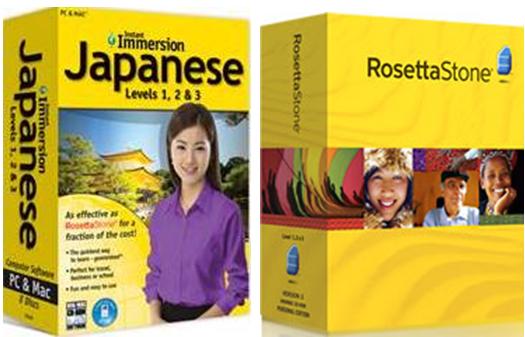 Trade dress questions between Topics (left) and
Rosetta Stone (right) will be decided in the Eastern District of Virginia
Folks may recall the suit Topics Entertainment Inc. filed last year in the Western District seeking a declaration that its packaging does not infringe any rights owned by competing language software maker Rosetta Stone Ltd. (STL post here.)
In particular, Topics asked the court to find that its “use of the color yellow, black font lettering, small blue icons, and pictures of smiling individuals is proper and not in violation of any rights held by Rosetta,” and that “Rosetta has no trademark or trade dress rights to the color yellow, black lettering, small blue icons, or pictures of smiling individuals.”
Topics’ filing beat Rosetta Stone’s mirror image filing in the Eastern District of Virginia by two hours.
Rosetta Stone moved to dismiss the Western District action.
On Nov. 12, 2009, the Eastern District of Virginia stayed the Virginia action pending the Western District’s ruling on Rosetta Stone’s motion. It found: “[I]t is for the court in the Western District of Washington to decide whether the first-to-file rule applies.”
On Jan. 4, the Western District Judge Robert Lasnik concluded the first-to-file rule should not apply and the case should be litigated in Virginia.
The court found: “Although Topics states that it filed suit only after the parties’ negotiations reached an impasse, the record demonstrates that at the time, the parties were still engaged in active settlement negotiations. In fact, on Monday, October 5, Rosetta Stone’s counsel promised that the company would provide a new settlement proposal by Wednesday, October 7. Rather than waiting for the proposal, Topics filed suit. Its counsel’s e-mail notes the awaited settlement proposal and explains the rush to file suit: ‘We do want to see Rosetta’s proposal …. And, as I advised before, we do not want to give up the rights associated with having filed first.’ The record shows that while the parties were engaged in active settlement negotiations, Topics became concerned when Rosetta Stone would not agree to permit it to file its lawsuit first and rushed to file its lawsuit. In light of these facts, the Court finds that Topics’ lawsuit was anticipatory. Moreover, permitting Topics to gain from its tactic would encourage parties to precipitously abandon settlement negotiations to rush to the courthouse as Topics did.”
The court added: “[W]here, as here, ‘a declaratory judgment action has been triggered by a cease and desist letter, equity militates in favor of allowing the second-filed action to proceed to judgment rather than the first.’ Finally, the fact that the suits were filed only two hours apart supports the Court’s decision to depart from the first-to-file rule. Accordingly, because Topics’ suit was anticipatory, the Court find the first-to-file rule inapplicable and dismisses this action in favor of the Virginia action.”
The case cite is Topics Entertainment Inc. v. Rosetta Stone Ltd., 2010 WL 55900, No. 09-1408 (W.D. Wash. Jan. 4, 2010) (Lasnik, J.).
Michael Atkins
in Civil Procedure, Seattle Updates, Trade Dress
|
Post a Comment
| Email
| Print