
Entries in Trade Dress (53)
Western District Finds Trademark Claims Had Enough Merit to Avoid Fees Award
In Atlas Equipment Co., LLC v. Weir Slurry Group, Inc., plaintiff and a third-party defendant sought attorney’s fees under the Lanham Act against counterclaimants/third-party plaintiffs Weir Slurry and Weir Minerals Australia, Ltd. (collectively, “Weir”), arguing those parties’ counterclaims and third-party claims for “reverse passing off” and trade dress infringement were baseless and pursued for too long. Though the Western District dismissed the subject claims on summary judgment, it did not agree they were so lacking that the prevailing parties deserved a fees award.
Judge Thomas Zilly explained:
“Before alleging its claim for ‘reverse passing off,’ Weir analyzed a pump sold by Atlas Equipment Co., LLC, and discovered that the pump casing, which originally bore Weir’s trademark, had been altered; metallographic testing revealed that the raised letters AH WARMAN had been ground off the casing. Although Weir was not able through discovery to establish that the adulterated casing was produced by Weir, a fact Weir was required to prove as an element of its ‘reverse passing off’ claim, the Court is satisfied that Weir’s assertion of the claim met the criteria of Rule 11(b). Moreover, Weir’s inability to trace the pump casing to one of its foundries does not undermine the legitimacy or reasonableness of Weir’s discovery efforts; Weir could not have known in the absence of discovery how the casing arrived at its doctored state. Finally, the Court is persuaded that Weir seasonably abandoned its ‘reverse passing off’ claim.
“With regard to Weir’s trade dress infringement claim, the Court concludes that Weir relied on a ‘good faith argument for an extension … of existing law.’ Weir raised genuine issues of material fact as to two of the three elements of its trade dress infringement claim, and as to the other element, namely functionality, the law is not fully developed and Weir presented non-frivolous, and rather challenging, contentions to support its position. Finally, the Court also takes into account that the party initiating this declaratory judgment action was Atlas Equipment Co., LLC, and not Weir.”
The case cite is Atlas Equipment Co., LLC v. Weir Slurry Group, Inc., 2009 WL 4430701, C07-1358Z (W.D. Wash. Nov. 30, 2009) (Zilly, J.).
 Michael Atkins
in Attorney's Fees, Lanham Act Section 43(a), Seattle Updates, Trade Dress
|
Michael Atkins
in Attorney's Fees, Lanham Act Section 43(a), Seattle Updates, Trade Dress
|
 Post a Comment
|
Post a Comment
|  Email
|
Email
|  Print
Print
Court Finds Ex Parte TRO Not Justified in Trade Dress Case
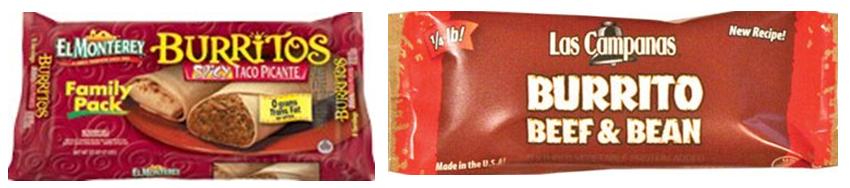 Plaintiff’s (left) and defendant’s trade dress: Ex parte relief not appropriate
Ruiz Food Products, Inc., filed suit in the Eastern District of California against Camino Real Foods, Inc., alleging that Camino’s burrito packaging is confusingly similar to its own.
Ruiz immediately moved for an ex parte temporary restraining order. On Oct. 2, the court denied the motion, finding that the parties’ attorneys had been in contact about the dispute, so there was no need to exclude Camino’s attorney from the process. The issue, the court found, was better suited for a motion for preliminary injunction where both parties could actively participate.
“Under Rule 65(b), a court may issue an ex parte temporary restraining order only if: (1) it clearly appears … that immediate and irreparable injury, loss, or damage will result to the applicant before the adverse party or that party’s attorney can be heard in opposition, and (2) the applicant’s attorney certifies to the court in writing the efforts, if any, which have been made to give the notice and the reasons supporting the claim that notice should not be required. Rule 65(b)’s requirements are ‘stringent,’ and temporary restraining orders that are granted ex parte are to be ‘restricted to serving their underlying purpose of preserving the status quo and preventing irreparable harm just so long as is necessary to hold a hearing, and no longer.’
“Here, Plaintiff has not sufficiently met its burden of justifying an ex parte restraining order. From Plaintiff’s submissions, it is apparent that counsel for both Plaintiff and Defendant have been in contact with each other over the allegedly infringing trade-dress. What is missing from the application is an adequate explanation of ‘the reasons supporting the claim that notice should not be required.’ Ex parte relief is not appropriate. The Court instead will treat the motion as a request for a preliminary injunction and set a briefing schedule and hearing date.”
TROs are tough to get — especially ex parte TROs. You need to convince the court there’s good reason to exclude the other party from the process. That evidence usually is hard to come by.
The case cite is Ruiz Food Products, Inc. v. Camino Real Foods, Inc., 2009 WL 3234145, No. 09-1731 (E.D. Calif. Oct. 2, 2009).
Michael Atkins
in Civil Procedure, Trade Dress
|
1 Comment
| Email
| Print
Ninth Circuit Affirms Injunction Against Nutritional Supplement Seller
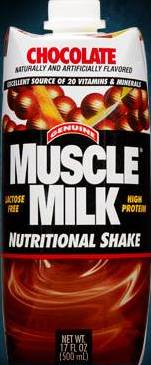 Plaintiff CytoSport, Inc., sued Vital Pharmaceuticals, Inc., in the Eastern District of California for trademark and trade dress infringement. CytoSport then moved for a preliminary injunction enjoining Vital from marketing, selling, advertising or promoting a liquid protein-based nutritional supplement using the name MUSCLE POWER or any other trademark confusingly similar to plaintiff’s MUSCLE MILK trademark. CytoSport (CS) also sought to enjoin Vital (VPX) from using trade dress that is confusingly similar to its trade dress.
On May 6, Judge Frank Damrell, Jr., granted CytoSport’s motion. The court concluded: “Plaintiff has demonstrated a reasonable likelihood of success in demonstrating that defendant’s use of its MUSCLE POWER® trademark and trade dress infringes plaintiff’s MUSCLE MILK® trademark and trade dress, that plaintiff is likely to sustain irreparable harm to its reputation and customer goodwill absent preliminary relief, the balance of equities tips in plaintiff’s favor in light of its longstanding reputation in the community and use of the MUSCLE MILK® trademark, and the public is served by issuance of the requested injunction which seeks to avoid customer confusion in the marketplace and permits plaintiff to control its products’ reputation.”
On the trade dress issue, the court found: “The features of CS’s trade dress which have been employed by VPX include the following: (1) the package front of the MUSCLE POWER product is visually divided into three sections, top, middle, and bottom; (2) on the middle portion of the package, the word MUSCLE is prominently displayed above the second word of the composite mark in all capital letters in a bold, block-letter, white-colored font on a dark background; (3) on the lower portion of the package a depiction of a swirled colored liquid appears reflecting the color of the product in the package, i.e., brown for chocolate, red for strawberries and cream, etc.; (4) on the top portion of the package, an identification of the flavor in words and a picture appears; (5) on the side of the package, the MUSCLE POWER mark is printed in bold, block-letter font and oriented so the consumer can read the words from the bottom to the top of the package; and (6) VPX uses the Tetra-Pak packages which are created by printing a label directly on to a flat piece of packaging material that is subsequently folded onto a three-dimensional carton that can be filled with the product.
“Defendant’s efforts to expose trivial distinctions between the two marks are unimpressive. VPX points to only subtle differences between the way the marks are used, such as the red outline around its brand name, as opposed to plaintiff’s black outline, and the ‘splash’ on the bottom of its package instead of plaintiff’s ‘swirl.’ These minor differences are ‘trivial distinctions’ especially when viewing the products in full, as they appear in the marketplace. Seen in this light, the marks are glaringly similar.”
Vital appealed these findings. On Oct. 13, the Ninth Circuit affirmed in short order, stating: “We conclude that the district court did not rely on an erroneous legal premise or abuse its discretion in concluding that Cytosport was likely to succeed on the merits and showed a strong likelihood that it would suffer irreparable harm if the preliminary injunction did not issue. Accordingly, we affirm the district court’s order granting the preliminary injunction.”
The case cite is CytoSport, Inc. v. Vital Pharmaceuticals, Inc., 2009 WL 3287630, No. 09-15969 (9th Cir. Oct. 13, 2009).
Michael Atkins
in Trade Dress, Trademark Infringement
|
Post a Comment
| Email
| Print
Topics Entertainment Sues Rosetta Stone for Declaration of Noninfringement
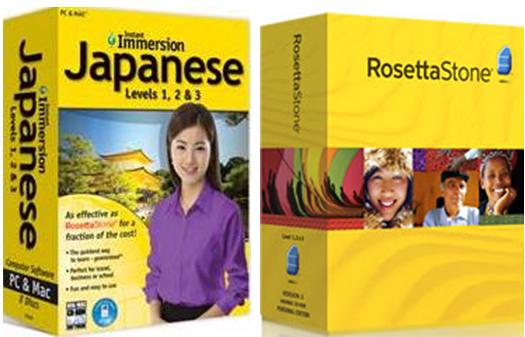 Trade dress infringement?
Topics Entertainment’s (left) and Rosetta Stone’s packaging
On Oct. 5, Renton, Wash.-based Topics Entertainment, Inc., filed suit in the Western District against Rosetta Stone, Ltd., seeking a declaratory judgment that the packaging of its INSTANT IMMERSION-branded language learning software does not infringe Rosetta Stone’s trademark or trade dress rights.
The complaint requests a judgment “declaring that Topics’ use of the color yellow, black font lettering, small blue icons, and pictures of smiling individuals is proper and not in violation of any rights held by Rosetta,” and that “Rosetta has no trademark or trade dress rights to the color yellow, black lettering, small blue icons, or pictures of smiling individuals.”
The complaint also prays for a judgment “declaring that Topics’ use of the phrase ‘As effective as Rosetta Stone for a fraction of the cost!’ does not constitute actionable false advertising.”
The complaint alleges an actual controversy exists because Rosetta Stone sent cease-and-desist letters threatening “alternative measures” to settlement if Topics did not comply with its demands.
Rosetta Stone has not yet answered Topics’ complaint.
The case cite is Topics Entertainment, Inc. v. Rosetta Stone, Ltd., No. 09-1408 (W.D. Wash.).
Michael Atkins
in Seattle Updates, Trade Dress, Trademark Infringement
|
Post a Comment
| Email
| Print
Ninth Circuit Finds No Secondary Meaning, No Foul in Trade Dress Case
 Art Attacks’ “Spoiled Brats” designs (top) and MGA’s “Bratz” dolls:
No secondary meaning, no foul
Plaintiff Art Attacks Ink, LLC, sells a “Spoiled Brats” collection of t-shirts featuring cartoonish, predominantly female characters, with oversized eyes, disproportionately large heads and feet, makeup, and bare midriffs. Defendant MGA Entertainment Inc. sells “Bratz” dolls, which, like Art Attacks’ designs, feature large eyes, heavy makeup, oversized heads and feet, and bare midriffs. Art Attacks cried foul and sued for trademark and trade dress infringement, among other claims.
A jury found for MGA on Art Attacks’ trademark infringement claim, but could not reach a verdict on its trade dress and other claims. MGA then moved for judgment as a matter of law, which the Southern District of California granted.
Art Attacks appealed. On Sept. 16 the Ninth Circuit affirmed, rejecting Art Attacks’ attempts to establish secondary meaning. With regard to Art Attacks’ arguments about purchasers’ perception, the court found:
“In its attempt to show purchaser perception of an association between the Spoiled Brats’ characteristics and a single source, Art Attacks largely reiterates its widespread dissemination arguments. Art Attacks again focuses on the number of attendees at county fairs, and additionally cites expert testimony identifying the Spoiled Brats defining features. Art Attacks correctly points out that direct survey evidence of purchaser perception is not required. Nevertheless, Art Attacks fails to demonstrate that purchasers of a product that displayed large eyes, oversized feet, and other characteristics typical of the Spoiled Brats would link that product with a single source. The only source of such evidence is the testimony of Tammie Gallagher, who said that she would associate the Spoiled Brats image with Art Attacks no matter where she saw it. Testimony from a single source is insufficient to demonstrate secondary meaning. A reasonable jury could not have found sufficient purchaser association between Spoiled Brats trade dress and Art Attacks to establish secondary meaning.”
The court also rejected Art Attacks’ proof of secondary meaning through advertising, extent and exclusivity of use, and actual confusion.
The case cite is Art Attacks Ink, LLC v. MGA Entertainment Inc., __ F.3d __, 2009 WL 2950659, No 07-56110 (9th Cir. Sept. 16, 2009).