
Entries in Trade Dress (53)
Western District Denies Injunction Against Canadian Supplement Seller
Plaintiff Preferred Nutrition, Inc., sells health supplements.
It hired defendant Lorna Vanderhaeghe, a Canadian citizen, as an independent consultant to help launch a new line of women’s supplements in Canada. Each supplement in the line ends with the suffix “Sense,” such as ESTROSENSE and MENOSENSE. Ms. Vanderhaeghe’s name and likeness appear on each supplement’s label.
Thereafter, Preferred Nutrition and the Everett, Wash.-based plaintiff Natural Factors Nutritional Products, Inc., began working with Ms. Vanderhaeghe to launch a similar line of products in the United States. From 2003 to 2008, the parties collaborated to sell eight SENSE products in the U.S., which did not feature Ms. Vanderhaeghe’s name or likeness.
In 2008, Natural Factors approached Ms. Vanderhaeghe about using her name and likeness on the American SENSE line. In 2009, it revised its labels to include Ms. Vanderhaeghe’s name and likeness, but later removed references to her. Around the same time, Preferred Nutrition likewise removed Ms. Vanderhaeghe’s name and likeness from its products in Canada.
By January 2010, both Preferred Nutrition and Natural Factors ended their relationship with Ms. Vanderhaeghe, who had made it known she intended to start a competing line of supplements.
In the spring of 2010, Ms. Vanderhaeghe launched a line of women’s supplements in Canada. Each was branded with a name ending in the suffix “Smart,” including ESTROSMART and MENOSMART — the same prefixes used from the SENSE line of products. She also prepared to launch a similar line in the United States.
The only way Americans can purchase Ms. Vanderhaeghe’s SMART products is to travel to Canada or to purchase them from a Canadian online retailer who sells to Americans. Ms. Vanderhaeghe does not sell any products directly from her Web site.
Preferred Nutrition and Natural Factors sued Ms. Vanderhaeghe in the Western District for trademark and trade dress infringement, and moved for a preliminary injunction. The injunction, the court noted, “would prevent Ms. Vanderhaeghe from doing anything to promote her SMART products in the United States or Canada, including the SMART names and the trade dress of the SMART products. It would also require her to refrain from ‘engaging in any acts of unfair competition against [Preferred Nutrition] or [Natural Factors].’ It would force her to stop seeking United States trademark registrations for her products, and to ‘immediately cancel or withdraw’ all pending state and federal trademark registrations.”
Western District Judge Richard Jones denied the motion.
“The court declines to enjoin Ms. Vanderhaeghe’s indirect sales to Americans. The sole claim for which Plaintiffs have established a likelihood of success on the merits is their claim for trade dress infringement. The court does not find a strong likelihood of success even on that claim. Plaintiffs have proven irreparable harm only because they enjoy a presumption of irreparable harm. The balance of hardships, however, strongly favors Ms. Vanderhaeghe. Ms. Vanderhaeghe should not be forced to forego lawful foreign product sales merely to permit Plaintiffs to cut off an unknown volume of sales to Americans.”
The court also noted it “does not have jurisdiction over Ms. Vanderhaeghe’s sales of her products to Canadians. That is a matter for the Canadian court system” and found that Ms. Vanderhaeghe’s plans to enter the U.S. market by selling her products directly to Americans was “too indefinite to support an injunction.”
The case cite is Preferred Nutrition, Inc. v. Vanderhaeghe, No. 10-907 (W.D. Wash. Nov. 22, 2010) (Jones, J.).
 Michael Atkins
in Seattle Updates, Trade Dress, Trademark Infringement
|
Michael Atkins
in Seattle Updates, Trade Dress, Trademark Infringement
|
 Post a Comment
|
Post a Comment
|  Email
|
Email
|  Print
Print
Nickelodeon's "Visual System" Functional, Not Protectable as Trade Dress
Plaintiff and counterclaim defendant The Jumpitz Corp. is a San Diego-based performance group that performs live song and dance for preschool-aged children. It also markets itself through its Web site, www.jumpitz.com. It first used the JUMPITZ mark in December 2007.
Defendant and counterclaim plaintiff Viacom International, Inc., owns the MTV and Nickelodeon television networks. On or about May 1, 2009, MTV began marketing a live-action children’s television program called “The JumpArounds” (a name it later changed to “The Fresh Beat Band”).
On May 15, 2009, Jumpitz filed suit in the Southern District of California for trademark and trade dress infringement. Viacom counterclaimed for trade dress infringement.
In particular, Viacom alleged that Jumpitz infringed Viacom’s trade dress by infringing Nickelodeon’s “visual system,” which Viacom asserted is made up a particular color palette (“distinctive shades of orange, green, and cyan blue”) and design (“‘soft’ and ‘whimsical’ geometric shapes as mortise or framing devices”). Viacom defined a “visual system” as “the visual expression of a brand, including through color, imagery, and typography, so as to promote a consistent, coherent, and distinctive brand image.”
Jumpitz moved for summary judgment.
On Aug. 13, the court found Viacom’s “visual system” was functional and, therefore, was not protectable as trade dress.
Its discussion is interesting.
The court noted Nickelodeon’s creative director, Richard Hicks, admitted that “‘A significant portion of Nickelodeon’s audiences is comprised of young children, many of whom are not yet of reading age and therefore identify brands not by words but instead by visual elements, including colors and shapes.’ Mr. Hicks also states, ‘Colors are among the first things children are able to distinguish ….’ This evidence demonstrates that the use of colors is important to Viacom because of the limited cognitive abilities of children, the intended audience, not to distinguish its brand from other competitors in the market. Furthermore, there is no evidence in the record to demonstrate that Viacom’s use of ‘simple yet whimsical shapes’ is Viacom’s attempt at distinguishing the Nickelodeon brand from other competitors. Rather, it appears to be Viacom’s attempt to appeal to children, who are inherently less adept at cognitive functioning. Thus, the Court is not convinced that Viacom has adequately carried its burden of demonstrating that its ‘visual system’ is non-functional.”
The court added: “[T]he Court would be remiss if it did not express its concerns over affording trade dress protection to Nickelodeon’s broadly defined ‘visual system.’ Children present a unique audience and companies attempting to reach children must figure out how to reach children in light of their limited cognitive abilities. The use of bright, fun colors and whimsical, playful shapes are not quintessential Nickelodeon; they are tools that companies have used for years to reach children. Allowing Viacom to assert a protectable interest in its broadly defined ‘visual system’ would stifle competitors in the filed of children’s entertainment in a way not contemplated by the Lanham Act.”
The case cite is The Jumpitz Corp. v. Viacom Int’l, Inc., 2010 WL 3238953, No. 09-1063 (S.D. Calif. Aug. 13, 2010).
Western District Finds Knife Trade Dress Functional, Dismisses Claim
Plaintiff Great Neck Saw Manufacturers, Inc., sued competitor Star Asia U.S.A., LLC, in the Western District for patent and trade dress infringement over the parties’ folding knives.
Here’s the claimed trade dress: “the shape, appearance, and location of (a) the blade holder, (b) the upper curve of the handle, (c) the bottom curve of the handle, (d) the upper notch in the handle, (e) the top rivets and pivot pins on the side wall of the handle, (f) the large pivot on the side wall of the handle, (g) the curved front and rear ends of the handle, (h) the handle as viewed from the rear, (i) the handle as viewed from the top, and (j) the handle as viewed from the bottom, as well as (k) the shape, appearance and relative thickness of the layers in the handle as viewed from the top and bottom.”
Defendant Star Asia moved for summary judgment based on the trade dress’ functionality, lack of distinctiveness, and insufficient evidence of likely consumer confusion.
On July 23, Judge Thomas Zilly granted the motion on each of these grounds.
Here’s a summary of the discussion on functionality:
“Because Great Neck has an existing utility patent for the device at issue, Great Neck bears a ‘heavy burden of establishing that the elements of its alleged trade dress are merely ‘ornamental, incidental, or arbitrary.’ The Court HOLDS that, as a mater of law, Great Neck has not met and cannot carry this burden. The features of Great Neck’s utility knife that it asserts constitute trade dress, when viewed as a whole, simply offer ‘the actual benefit that the consumers wishes to purchase,’ namely a folding knife with an easily replaceable blade. Competitors have broad rights to copy successful product designs when those designs are not protected by (utility or design) patents. It is not unfair competition for someone to trade off the good will of a product; it is only unfair to deceive consumers as to the origin of one’s goods and thereby trade off the good will of a prior producer.’ Under the four-factor test outlined in Clamp Mfg. [Co. v. Enco Mfg. Co., 870 F.2d 512, 516 (9th Cir. 1989)], Great Neck’s trade dress is de jure functional and therefore not entitled to trade dress protection.”
The case cite is Great Neck Saw Manufacturers, Inc. v. Star Asia U.S.A., LLC, 2010 WL 2949296, No. 06-647 (W.D. Wash. July 23, 2010) (Zilly, J.).
Michael Atkins
in Seattle Updates, Trade Dress
|
Post a Comment
| Email
| Print
Rawlings Sues Under Armour for Use of Rebranded Batting Helmet in Ads
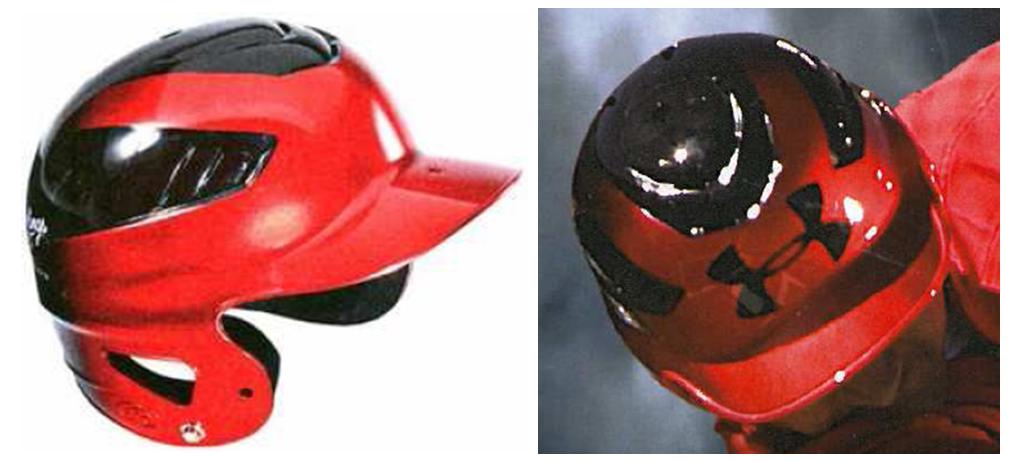 Rawlings’ complaint alleges Under Armour (right) put its logo on
Rawlings’ helmet (left) without Rawlings’ permission.
On June 7, Rawlings Sporting Goods Co. sued Under Armour, Inc., in the Western District for false designation of origin, trade dress infringement, and other Lanham Act causes of action.
The reason?
Rawlings says Under Armour put its logo on Rawlings’ COOLFLO red-and-black batting helmet without Rawlings’ permission and used the helmet in at least two magazine advertisements for Under Armour batting gloves.
The complaint alleges that “Customers and the public are likely, upon seeing the UA Logo affixed to the COOLFLO® Helmet Mark and the COOLFLO® Trade Dress, to mistakenly believe either that the products being sold in association with the helmet originate from Rawlings or to believe that the helmet originates from Under Armour. Customers may also believe that Rawlings sponsors, is affiliated with or endorses the goods sold in association with the COOLFLO® Helmet upon which the UA Logo has been affixed.”
Under Armour has not yet answered Rawlings’ complaint.
The case cite is Rawlings Sporting Goods Co. v. Under Armour, Inc., No. 10-933 (W.D. Wash.).
Michael Atkins
in Lanham Act Section 43(a), Seattle Updates, Trade Dress
|
Post a Comment
| Email
| Print
No Summary Judgment Dismissal in Pull-Tab Trade Dress Case

Plaintiff Bonanza Press, Inc., and defendant Arrow International, Inc., sell pull-tab tickets used in games of chance. A pull-tab ticket has at least one perforated section that can be removed or lifted to reveal a symbol indicating whether the ticketholder is a winner.
Bonanza has a federal registration for its design, which it describes as “a configuration of a circular shaped gaming ticket having a concentric circular pull-away portion.” Arrow’s pull-tabs are either octagonal with a circular pull-away portion or octagonal with an octagonal pull-away portion.
Bonanza sued Arrow in the Western District for trade dress infringement. Arrow moved for summary judgment on the ground that its octagonal pull-tabs are not likely to be confused with Bonanza’s circular pull-tabs.
On May 27, Western District Judge Richard Jones found that Bonanza’s mark is weak, there was no evidence of actual confusion, and there was no evidence that Arrow developed its design with malicious intent. However, the court also found that the designs are similar at least to some degree and purchasers do not exercise much care when buying pull-tabs. Together, the court found the Sleekcraft factors did not lead to one conclusions and, therefore, summary judgment dismissal was not appropriate.
The court also denied Arrow’s motion for summary judgment on Bonanza’s unfair competition claim.
The court granted Arrow’s motion on Bonanza’s Consumer Protection Act Claim because Arrow has not made any sales in Washington. “Potential sales do not directly or indirectly affect Washingtonians,” the court found. “Thus, because there is no evidence that Arrow’s practices affect Washington’s trade or commerce, its WCPA claim fails as a matter of law.”
The case cite is Bonanza Press, Inc. v. Arrow International, Inc., No. 2010 WL 2196112, No. 08-1624 (W.D. Wash. May 27, 2010) (Jones, J.).
Michael Atkins
in Consumer Protection Act, Seattle Updates, Trade Dress
|
Post a Comment
| Email
| Print